The food industry is currently facing increasingly demanding challenges, including rising operational costs, labor shortages, the need to ensure high standards of quality and food safety, and constant pressure to increase productivity while reducing waste. In this context, industrial automation plays a strategic role in transforming production facilities, enabling companies to respond more quickly, efficiently, and sustainably to market demands.
By integrating robotics, intelligent systems, and industrial digitalization technologies, it is possible to automate critical processes, optimize operations, and create production lines that are more flexible, safer, and more scalable.
ESI Robotics develops industrial automation solutions tailored to the specific needs of each industry, including the food sector, with projects ranging from handling and packaging operations to complete end-of-line and robotic palletizing systems.
Why is automation becoming increasingly important in the food industry?
Food manufacturing facilities operate in a highly competitive environment, where factors such as production consistency, hygiene, traceability, and logistics efficiency are essential.
Automation helps address these challenges directly through:
- Reduced dependence on manual processes;
- Increased production capacity;
- Greater repeatability and product quality;
- Waste reduction;
- Improved ergonomic and safety conditions;
- Enhanced process control and traceability;
- Flexibility for different product formats and references.
In addition, the integration of industrial robots and intelligent systems allows manufacturers to maintain high production rates with exceptional precision, even in demanding food production environments. Digitalization and automation are profoundly transforming manufacturing processes, creating smarter, more connected, and data-driven factories.
Industrial automation applications in the food industry
With ESI Robotics practical case studies
Industrial automation can be applied across virtually every stage of food production, from product handling to end-of-line operations. The impact becomes even clearer when each technology is associated with real industrial applications.
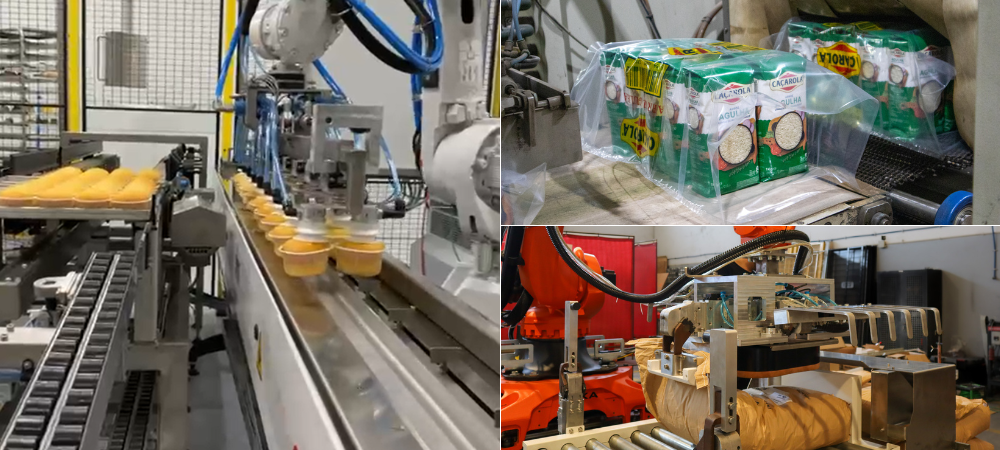
Handling, Pick & Place, and Automated Packaging
Robotic systems enable the automation of repetitive handling tasks involving products, packaging, or food components. These solutions provide higher production speed, precise positioning, reduced errors, and continuous, consistent operation.
Packaging is one of the areas where automation delivers the most immediate impact. The use of robotic cells and automated systems increases line throughput, ensures process consistency, reduces waste, and quickly adapts to different packaging formats.
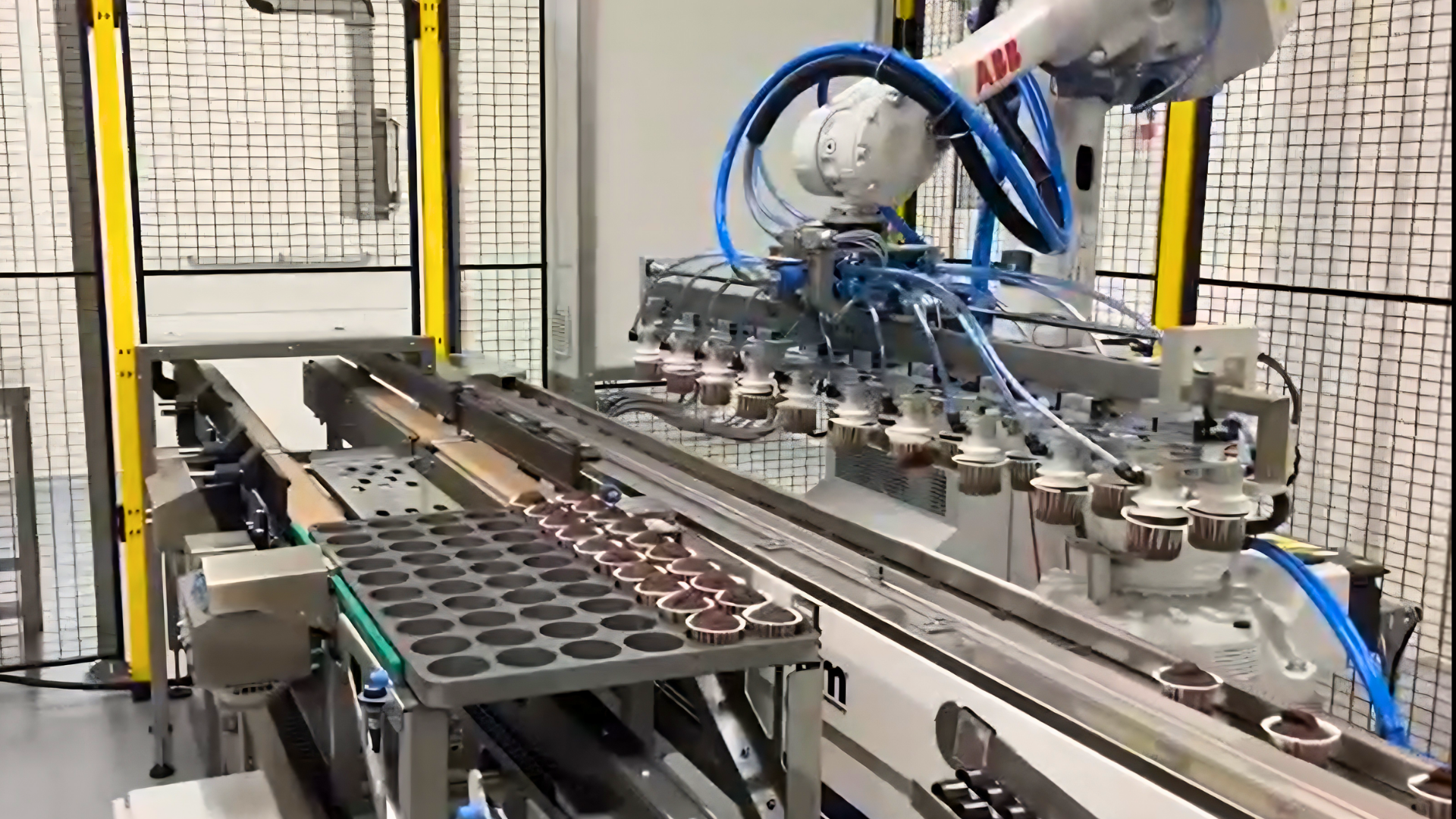
ESI Robotics Project – Robotic Pick & Place Cell for Muffins
One example of this application is the automated muffin packaging system developed by ESI Robotics, where a custom-designed gripper was engineered specifically for product handling. The system removes muffins from trays and places them directly into the packaging machine with high precision and repeatability.
The entire tray management system was also fully automated, including a return conveyor for empty trays, ensuring continuous production flow while reducing manual intervention.
Robotic Palletizing
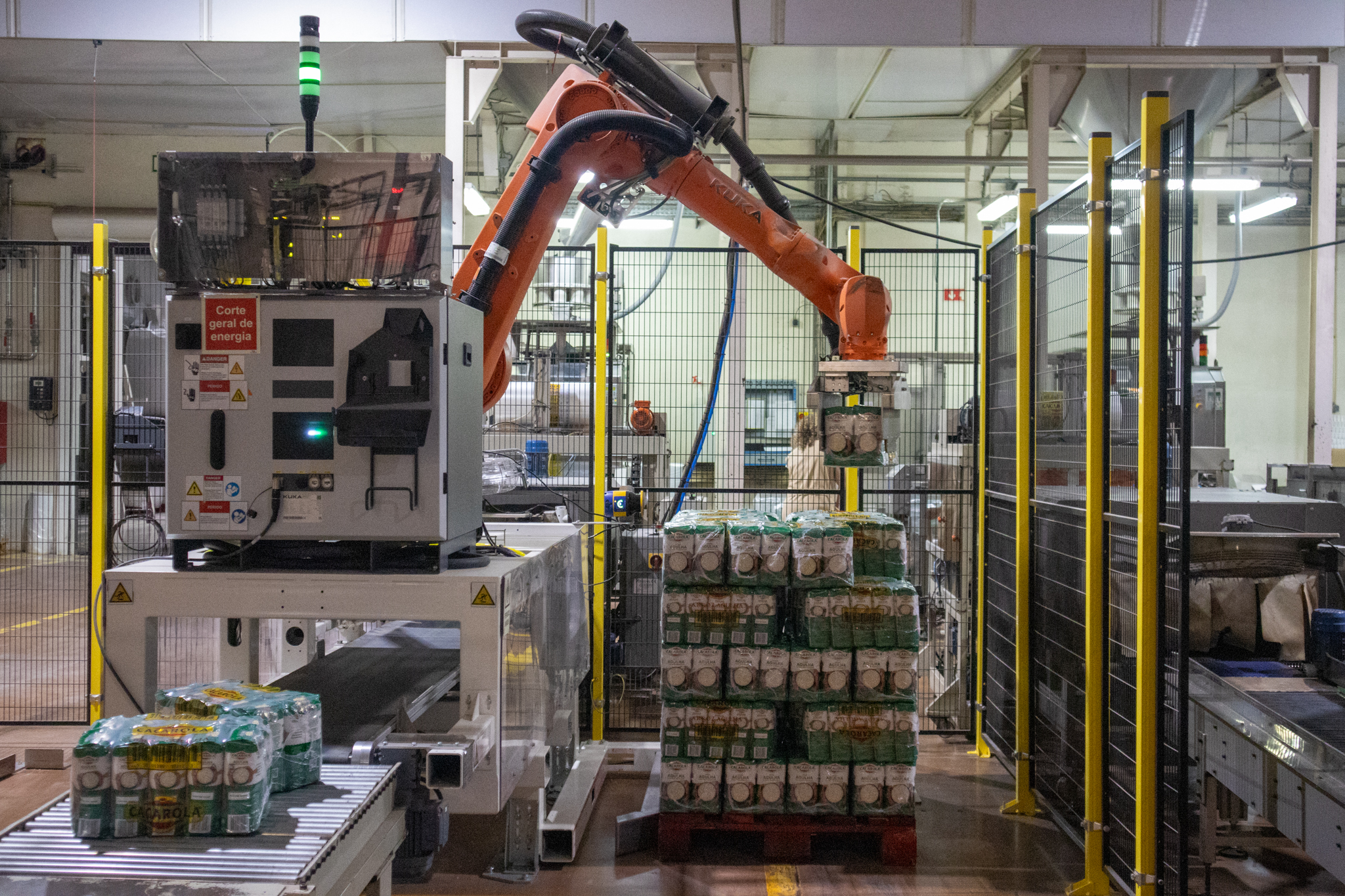
Palletizing is one of the most relevant applications of industrial robotics in the food industry. These systems automate pallet formation with different stacking patterns, ensure transport stability, reduce physical strain on operators, and significantly increase productivity.
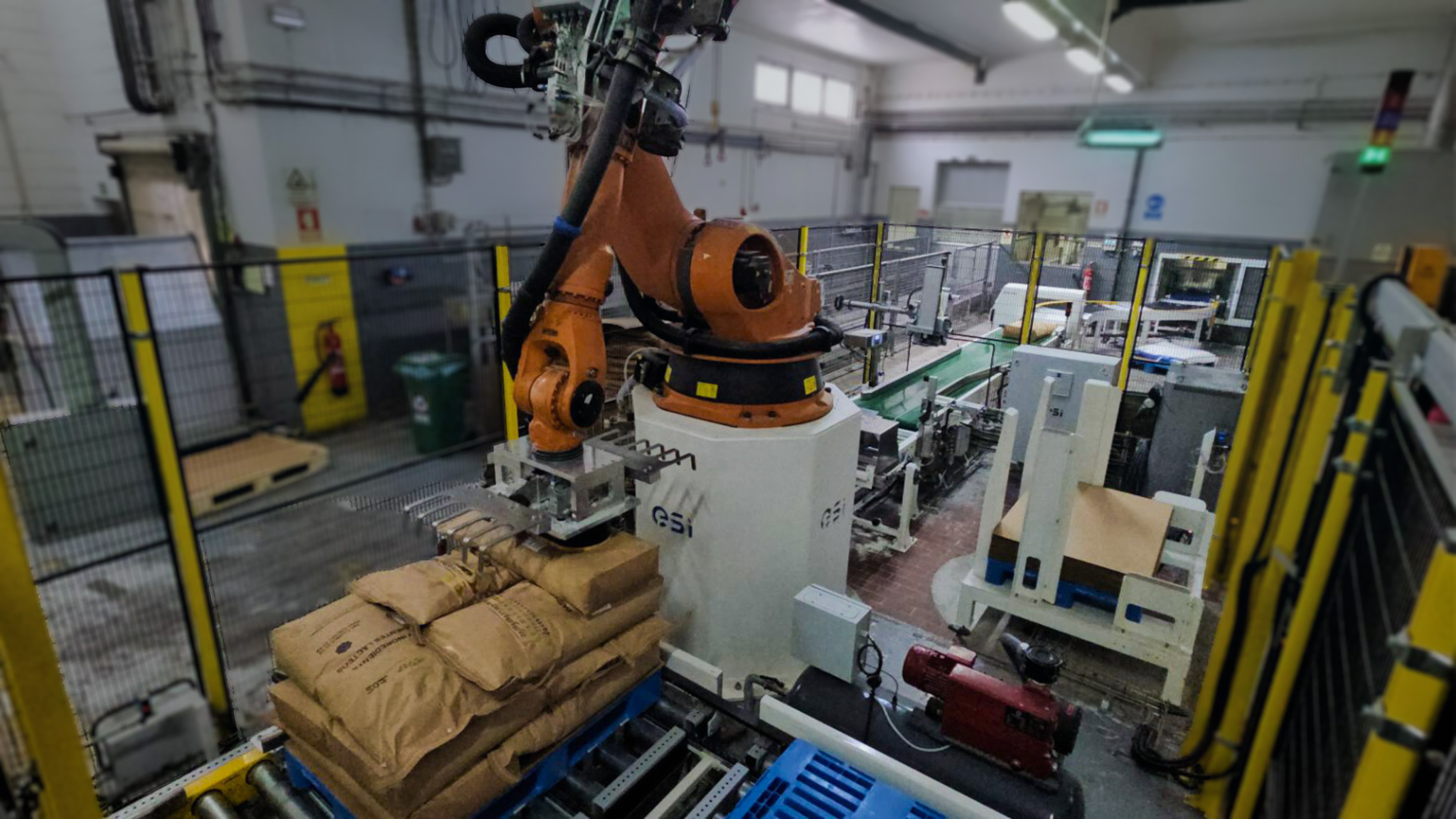
ESI Robotics Project – Robotic Palletizing of Powdered Milk Bags
This project involved the implementation of a robotic cell capable of palletizing powdered milk bags of different weights (10 kg and 25 kg) with high operational flexibility.
One of the key elements of the solution is the bag handling system specifically developed for this process, combining different handling technologies to ensure safe and precise product manipulation.
The solution supports multiple palletizing patterns and guarantees pallet stability even when packaging formats vary.
Automated End-of-Line Systems
End-of-line automation eliminates production bottlenecks and creates more efficient and predictable workflows. These solutions may include automatic conveying systems, box forming and sealing, labeling, packaging, palletizing, pallet wrapping, and integration with logistics systems.
One example of this approach is the robotic rice palletizing project developed by ESI Robotics, where a robotic cell was implemented to adapt different stacking patterns and meet specific logistics requirements.
The result is a more consistent operation with higher production throughput and greater reliability throughout the logistics process.
ESI Robotics Project – Robotic Rice Palletizing
In this project, a robotic palletizing solution was developed for rice packages with the goal of increasing end-of-line efficiency and ensuring greater stability during product transport and storage. The robotic cell automates pallet formation using different stacking patterns, adapting to specific logistics requirements while reducing manual intervention in repetitive tasks.
This type of solution contributes to higher production rates and more consistent operations, even in highly demanding logistics environments.
The future of the food industry depends on automation
The food industry is undergoing a profound transformation. The need to produce more, with higher quality and lower operational impact, will continue to accelerate the adoption of robotic solutions and intelligent systems. Industrial automation is no longer just a competitive advantage - it has become an essential element in building more efficient, flexible, and sustainable operations.
With tailor-made solutions and advanced robotics integration, ESI Robotics continues to support companies in modernizing their production processes and shaping the future of the food industry.
Contact us and discover how to make your production more efficient!