Industrial final line automation for industrial cans
In a demanding production environment with high product variability, Colep Packaging challenged ESI Robotics to automate the end-of-line palletizing process for industrial cans. The existing process relied heavily on manual operations, involving repetitive handling, physical strain, and limitations in terms of consistency and throughput. On top of that, the need to handle multiple can formats and sizes, combined with different palletizing patterns, made the process particularly complex.
To meet these requirements, ESI Robotics developed a fully integrated robotic cell, designed and engineered specifically for this application.
The challenge
The project required a solution capable of addressing several demanding conditions:
- Correct orientation of industrial cans based on handle position;
- Stable alignment throughout the entire process flow;
- Automated formation of consistent can stacks (layers);
- Efficient palletizing of stacked units;
- Handling of multiple can sizes and formats;
- Support for both standard and inverted palletizing strategies.
This combination of requirements called for a robust yet highly flexible automation solution.
The solution developed by ESI Robotics
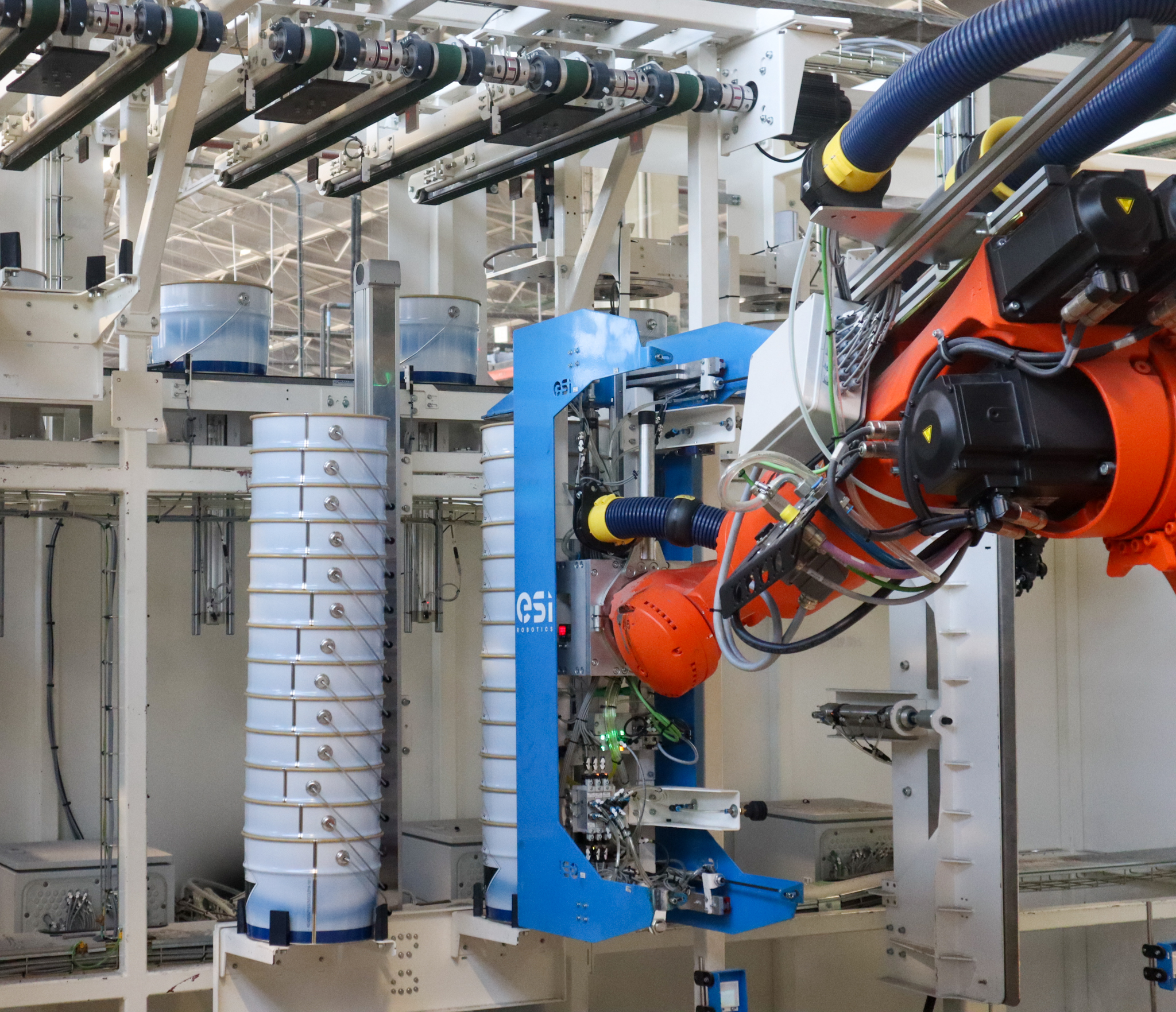
The robotic cell was designed as a fully integrated system, capable of managing the entire process in a continuous and automated flow.
A dedicated machine handles the orientation, alignment, and stacking of industrial cans, ensuring the formation of stable and repeatable stacks. The system uses the geometry of the can handles as a reference to guarantee correct positioning from the very first stage of the process.
A magnetic conveying system ensures controlled and synchronized transport between the different phases of the cell, minimizing misalignment and maintaining a smooth product flow.
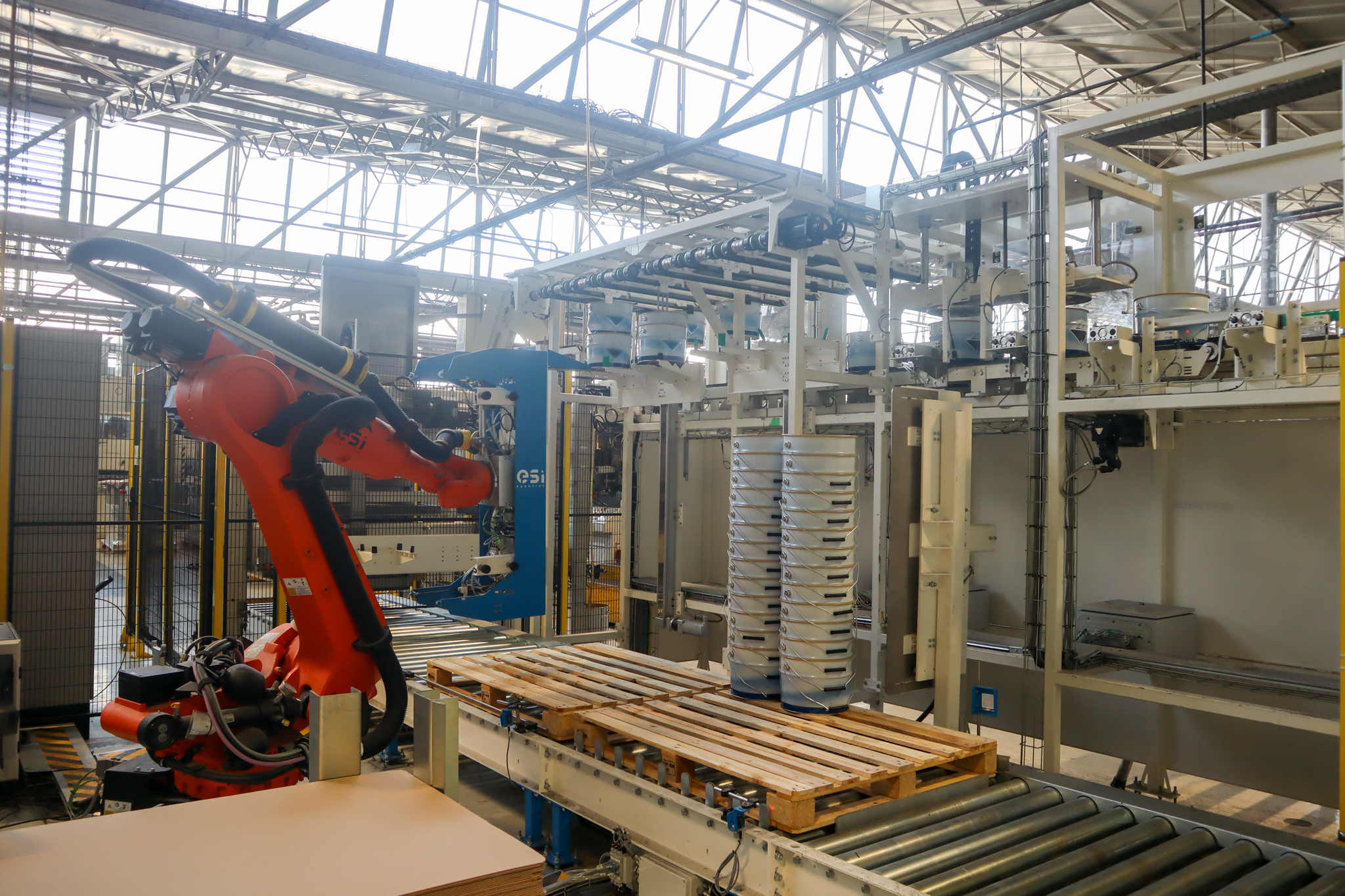
At the end of the process, an industrial robot picks up the stacks and places them onto pallets. The robotic gripper used in this operation was also developed by ESI Robotics, ensuring full compatibility with the product and high reliability in handling.
An automatic pallet dispenser is also integrated into the system, ensuring correct pallet supply and positioning at the palletizing station, contributing to continuous and uninterrupted operation.
Standard and inverted palletizing
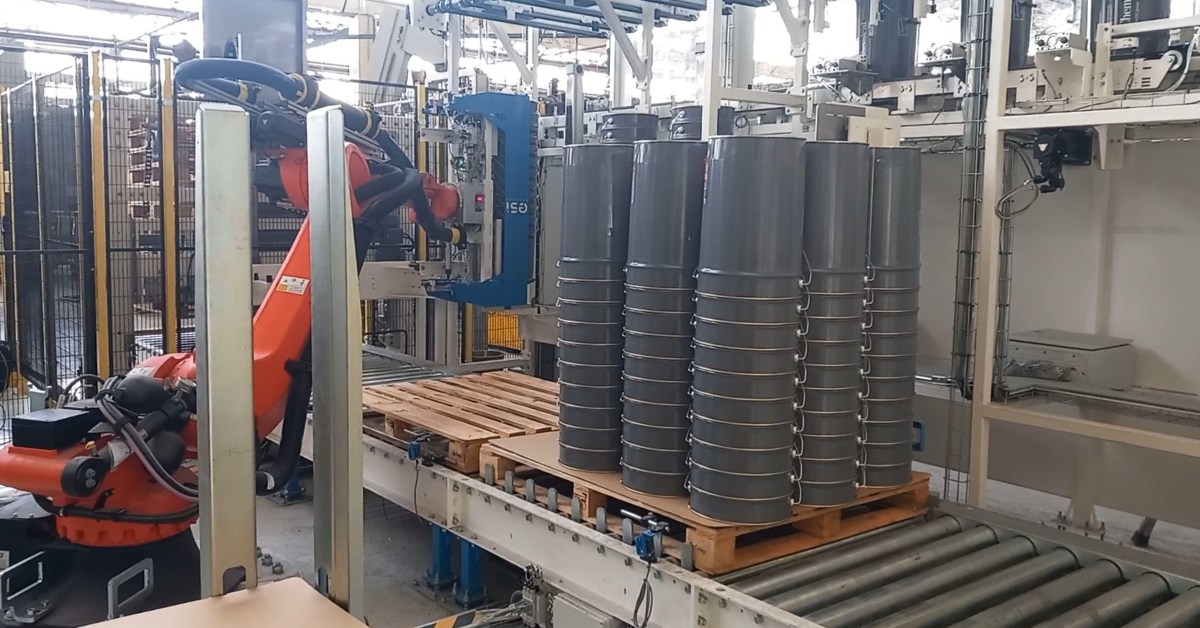
One of the key challenges of the project was the requirement to perform not only standard palletizing but also inverted stacking of industrial cans.
The solution enables:
- Standard orientation palletizing
- Inverted stack formation when required
- Full compatibility with all can formats
- Stable and repeatable performance regardless of configuration
This capability significantly increases operational flexibility, allowing pallet patterns to be adapted to different logistics and transport requirements without system modifications.
Results and benefits
The implementation of this robotic cell delivered significant improvements to the overall production process:
- Reduced manual handling and physical workload
- Increased productivity and throughput
- Improved consistency in stacking and palletizing quality
- High flexibility across different product types
- Optimized internal logistics flow
- Greater process control and repeatability
The result is a robust, flexible robotic cell designed to meet the demands of modern industrial environments, contributing to higher efficiency and the ongoing automation of end-of-line operations.
SEE ALSO: Industrial Robotics for CNC Operations in the Wood Industry Articles